
Award-Winning Protection from the Most Dangerous Air Pollution
Particulate matter 2.5 is widely considered the most dangerous air pollutant regarding human health risks. It is responsible for the vast majority of early deaths from air pollution, compared to other pollutants including ozone and gases.
The Cocoon Air Cleaner was designed to filter out PM2.5 particles from wildfire smoke. It won the US Environmental Protection Agency’s 2024 national award for the best air cleaner costing under $100 for removing indoor wildfire smoke. It also filters out PM2.5 particles of gases bound to particles, allergens and mold. It beat over 130 competing designs in the EPA contest.
See this presentation by the US EPA about the contest and the winning Cocoon Air Cleaner:
The Big Advantage
Unlike almost every other air cleaner, the Cocoon air filter can be washed and re-used many times To tell when it is dirty and losing its efficiency, put a piece of transparent tape on part of the filter bag. Air won’t flow through that part so it won’t get dirty and turn brown. It will contrast with the fabric around it.
The discovery
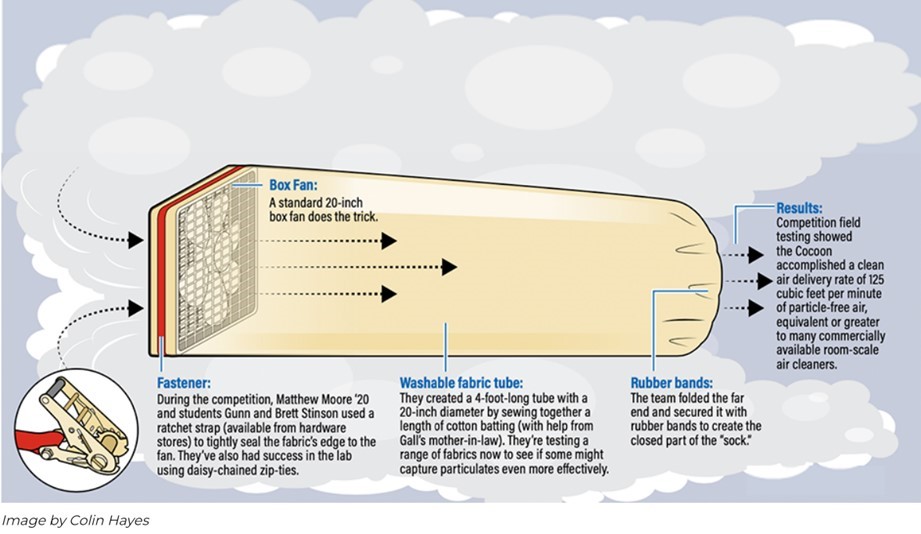
In response to the EPA Challenge, scientists at Portland State University Healthy Buildings Research lab tested common household fabrics as air filters. They discovered that cotton batting used for quilts and puffy clothes is an excellent air filter that removes particulate air pollution at a MERV 13 level, considered to be the standard for the best value in filtration. They used two layers of 3.5oz /100g weight batting to make a tube 20 inches in diameter and 4 feet long. To make the closed end they pinched one end of the bag together in the center and tied it closed. They put a 20 inch box fan in the open end to blow into it. The fan is set to high speed and inflates the bag and pushes air through the fabric which filters out air particles. This simple use of a great discovery won the EPA national award, beating over 130 other designs!
The Improvement
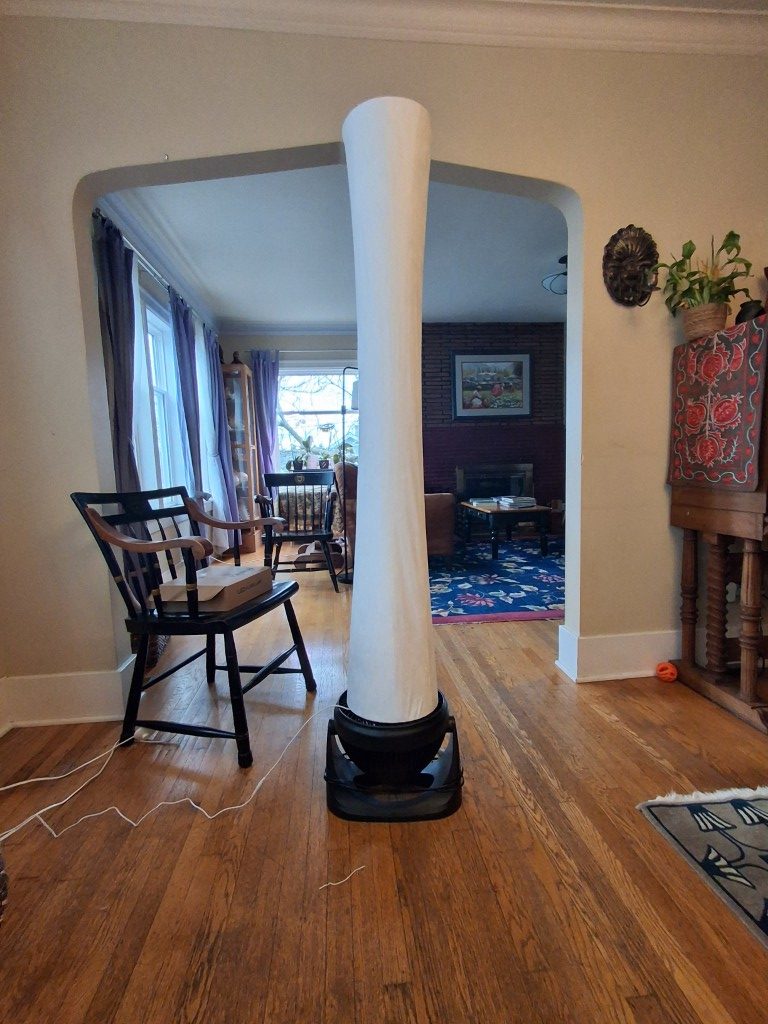
The Cocoon on the floor is a big obstacle and the floor blocks some of the air flow. The team at Cocoon Air Quality in Seattle turned it sideways to blow straight up. They changed the box fan to a powerful 14″ air circulator fan that is much quieter and more energy efficient than the box fan. The fan is pointed straight up and the filter bag opening is put around the rim of the fan and taped or tied there. Then the fan is placed next to a wall. The filter bag is lifted straight up and the closed end is taped to the wall. Now it is off the floor and quieter.
Now you can make a Cocoon Air Cleaner yourself with locally available parts!
ASSEMBLY INSTRUCTIONS
Step-By-Step Guidance

Step 1: Measure your fan and calculate the bag circumference
1. Measure the outer diameter of the fan’s circular body (widest point).
2. Calculate the circumference = diameter × π. 12.5 × 3.14 ≈ 39.3 in.
3. Round up for overlap/seam allowance → ~40 in.
You’ll cut your batting rectangle so its short side equals this circumference (≈40″) and its long side equals your target bag height (next step).
Step 2: Determine the bag height and prep the batting
The longer the bag, the more filter area and the better it cleans over time. Pick your target height (e.g., 40–60 in).
1. Unfold your batting until you have a double layer. Keep one factory fold intact—that fold will become a strong edge.
2. Lay the double-layer sheet on the floor/table. Align it square to floorboards or a straight edge.
3. Tape the corners (and the middle if needed) with low-tack tape to keep it from creeping.
Step 3: Mark and cut your rectangle
Width (circumference side): 40 in (from Step 1, rounded up). Height (bag height): 46 in (or your chosen height).
Pro tip: Flip your tape measure so the rigid back acts like a straightedge; draw clean lines with your marker.
Cut carefully with very sharp scissors. Keep the factory fold as one of the rectangle’s four edges.
Step 4: Reinforce all edges with packing tape
Batting edges can fray/tear. Build a strong “hem” on all four sides:
1. Lay packing tape along the edge (half on the fabric, half off).
2. Flip the piece and roll the tape over the edge so it bonds to both sides of the double-layer.
3. Repeat for all four edges (including the factory fold). This creates firm edges that hold subsequent seams.
Step 5: Form and tape the tube “sock”
1. Place the rectangle flat with reinforced edges facing up.
2. Fold the left and right long edges inward until they meet in the middle (no gaps).
3. Lay a long strip of packing tape down the center, bridging both reinforced edges to join them.
4. Wrap a bit of tape around the ends of this seam to lock it in.
5. You now have a large tube (open at both ends). Flatten that end and tape it closed: lay packing tape across the opening, flip, and roll tape over so the plastic-to-plastic bond locks it firmly. (The other end remains open—that’s where the fan will go.)
Step 6: Attach the bag to the fan and hang for vertical use
1. Lay the open end of the bag on the floor and fold a short cuff up to form a sturdy ring.
2. Turn the fan upside down and place it into this ring so the bag’s open edge rises up around the fan body.
3. Tape the bag’s edge to the fan housing all the way around with packing tape. Work in short segments; overlap slightly so there are no gaps for leaks.
4. Clip two small binder clamps near the top corners/edges of the bag.
5. Tie string to the clamps and tether to a push pin, wall hook, or a lamp/stand directly above. The fan should sit on the floor/table, pointing straight up into the bag.
FAN CHOICE
Box Fan vs. Air Circulator Fans
The Cocoon Air Cleaner can be used with either a standard box fan or a vortex-style air circulator fan, depending on your setup and what you already have available.
Box fans are usually the most affordable and widely available option. They have a large, flat, square shape that makes them easy to pair with a filter setup, and they are commonly sold in 20-inch sizes at hardware stores, big-box retailers, and online. They are a practical choice for low-cost wildfire smoke filtration, especially during emergencies when accessibility matters.
Vortex air circulator fans are designed to move air more forcefully throughout an entire room, rather than simply blowing air straight forward. Their focused airflow can help improve room-wide circulation, and many models are more compact than a traditional box fan. However, they may cost more and can vary more in shape and compatibility, so it is important to make sure the fan works with your Cocoon setup before purchasing.
You can typically find both box fans and vortex air circulator fans at retailers such as Home Depot, Lowe’s, Walmart, Target, Amazon, Costco, and local hardware stores. When shopping, look for a reliable fan with multiple speed settings, a stable base, and enough airflow for the size of the room where you plan to use it.

MAKE THE FILTER BAG
Cut & Tape the Batting Fabric
The Cocoon filter bag is made from cotton batting fabric, which is the same as the material used in quilting. Cut the fabric into a large “sock-like” bag that fits over the fan and secure it with a strap or band. This simple design helps pull smoky indoor air through the fabric filter, capturing fine particles while keeping the setup affordable, accessible, and reusable. After use, the cotton batting filter bag can be washed and reused, making it a practical option for wildfire smoke preparation.
Important Tip:
Air cleaners only clean the air in the room they are in. For full protection you need one in each room.

TEST IT
Test It in Your Own Space
Want to see The Cocoon in action? Place it in a closed room, create a small amount of visible smoke with incense, then turn on the fan and use a clock or stopwatch to see how quickly the smoke begins to clear. This simple visual test can help you understand how air moves through the filter bag and how the cleaner performs in your room. For best results, avoid overfilling the room with smoke, and remember never to leave burning incense unattended.
MAKE THE FILTER BAG
See The Cocoon Vertically and Horizontally
MAKE IT OR BUY IT
Fans and cotton batting are commonly available in most cities. It will take some hours and money to buy and assemble the parts. Or you can buy the whole air cleaner with all parts included. The Cocoon Air Cleaner is available from Cocoon Air Quality as a full kit with all the parts ready to assemble.